

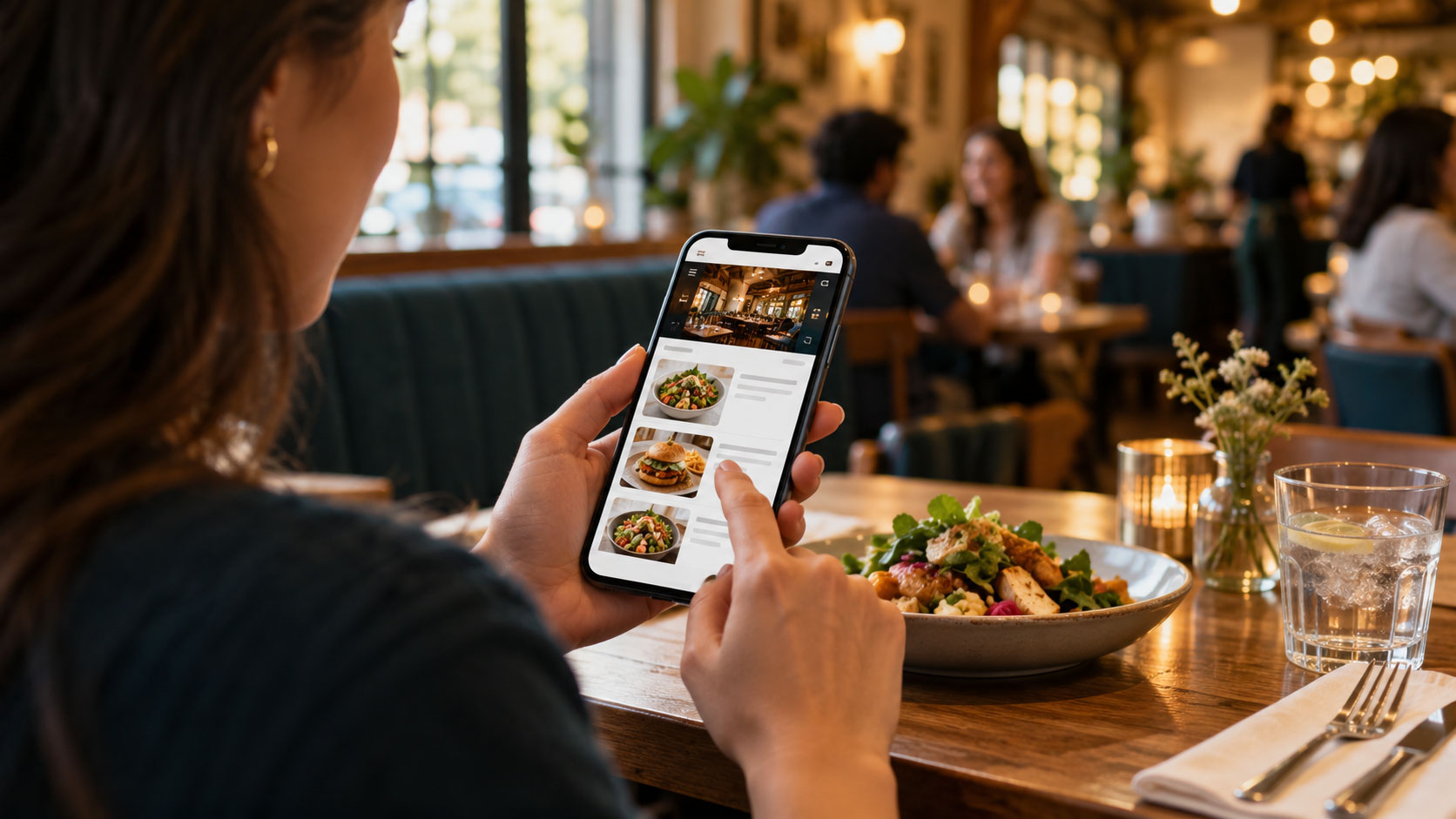
Customers Should Not Have to Understand Your Tech Stack
Your guests do not care which plugin handles a reservation, which POS powers an order, or which platform stores the menu. They care that the button works, the information is accurate, and the experience makes sense on their phone.
When restaurant technology is stitched together poorly, customers feel it immediately. They get bounced to unfamiliar pages, see mismatched menus, lose their cart, or wonder whether the reservation actually went through.
That kind of friction may seem small from the restaurant side, but it can completely change the customer experience. A guest who was ready to order can quickly become a guest who gives up. A customer who wanted to book a table may decide the process feels unreliable. Someone simply checking your menu may end up confused about which version is current.
The technology may be doing exactly what it was designed to do behind the scenes, but if the customer experience feels disjointed, the system is not really working as well as it should.
Good Integration Feels Boring in the Best Way
The ideal digital experience is almost invisible. A customer opens the site, finds the menu, chooses what they want, and completes the next step without thinking about the systems behind it. That simplicity usually takes more planning than a pile of apps and links.
Customers should not have to stop and think about whether they are still on your website, whether an ordering page is legitimate, or whether the reservation form actually belongs to your restaurant. The process should feel like one continuous experience, even when several different platforms are powering it behind the scenes.
That is what good integration does. It keeps the technology in the background so the customer can stay focused on the restaurant.
The website should act as the front door, while the technology behind it supports the experience instead of competing for attention.
Your Website Should Be the Orchestrator
Restaurants often end up with multiple systems because no single platform does everything perfectly. You may have one provider for online ordering, another for reservations, another for email marketing, and another for the POS. That is normal.
The problem starts when every system feels like its own separate destination.
Your website should be the place that brings those tools together. It should give customers one clear starting point for your menu, hours, location, reservations, ordering, catering, and other important actions.
From the customer’s perspective, they should not be navigating a collection of software products. They should be interacting with your restaurant.
That means buttons should be labeled clearly. Menus should match what customers can actually order. Hours should be consistent everywhere. Reservations and ordering should open in a way that feels intentional instead of sending customers through a maze of unrelated pages.
Small Friction Adds Up Quickly
Most customers will never tell you that your digital experience was confusing. They will simply leave.
A few extra clicks, a slow-loading ordering page, an outdated menu, or a login prompt at the wrong moment can be enough to interrupt the process. The customer may not think, “This restaurant has a poor technology integration strategy.” They will think, “This is annoying,” and move on.
That is why small details matter so much.
If a customer taps “Order Online,” they should know exactly what happens next. If they choose a location, the menu and hours should match that location. If they make a reservation, they should receive clear confirmation. If they are browsing on a phone, the whole process should feel designed for a phone.
Good restaurant technology removes questions instead of creating them.
Choose Tools by the Problem They Solve
Restaurants are constantly offered new software for ordering, loyalty, reservations, email, delivery, menus, analytics, scheduling, customer management, and more. Adding another tool only makes sense if it solves a real problem without creating three new ones for staff or customers.
Before adding technology, ask what should become easier afterward.
Will customers be able to order faster? Will staff spend less time updating the same information in multiple places? Will reservations be easier to manage? Will the restaurant gain information it can actually use?
If the answer is not clear, the tool may not be worth the extra login, subscription, training, and troubleshooting.
The best setup is not the one with the most features. It is the one that quietly works.
More Features Do Not Automatically Mean a Better Experience
It is easy to get pulled into feature comparisons when shopping for restaurant technology. One platform offers more integrations. Another has more reports. Another adds loyalty, email, or AI tools.
Those features can be useful, but only if they fit the way the restaurant actually operates.
A complicated platform with dozens of features staff never use is not necessarily better than a simpler setup that solves the right problems. In fact, too many disconnected tools can make the operation harder to manage and the customer experience less consistent.
The better question is not, “How much can this software do?”
It is, “What does this software make easier for the restaurant and the customer?”
Think About the Staff Experience Too
Customer-facing technology usually depends on staff keeping information current behind the scenes.
If changing your hours requires updates in five different places, something will eventually be missed. If menu changes have to be entered separately into the POS, website, ordering system, and PDF menu, inconsistencies become much more likely.
The same thing happens with pricing, sold-out items, holiday hours, location details, and promotions.
Better integration reduces duplicate work. When staff can update information once and trust that the right systems stay aligned, customers are more likely to see accurate information everywhere they look.
That is where good restaurant technology creates value that customers may never notice directly. The experience feels simple because the operation behind it is better organized.
A Simple Test Before Adding Another Platform
Before signing up for the next restaurant technology tool, ask a few basic questions:
- What specific problem are we trying to solve?
- Will this make something easier for customers?
- Will this reduce work for staff or add more steps?
- Does it integrate with the systems we already use?
- Will we have to maintain the same information in multiple places?
- What happens if the platform goes down or stops syncing?
- Will customers still feel like they are interacting with our restaurant?
If those answers are unclear, it may be worth slowing down before adding another system.
The Best Restaurant Tech Disappears Into the Experience
The best technology does not need to announce itself.
Customers do not need to know that your website is connected to your POS, your ordering provider, your reservation platform, and your marketing tools. They only need to feel that everything works together.
They find the right menu. They see accurate hours. They place an order. They reserve a table. They get confirmation. Nothing feels confusing, disconnected, or unfinished.
That is the goal.
National Restaurant Association research tracks broader shifts in restaurant operations, technology, and customer behavior. On the customer side, the goal is still simplicity. Our restaurant online ordering and restaurant website design services are built to make restaurant technology feel connected instead of forcing customers through a collection of unrelated tools.