

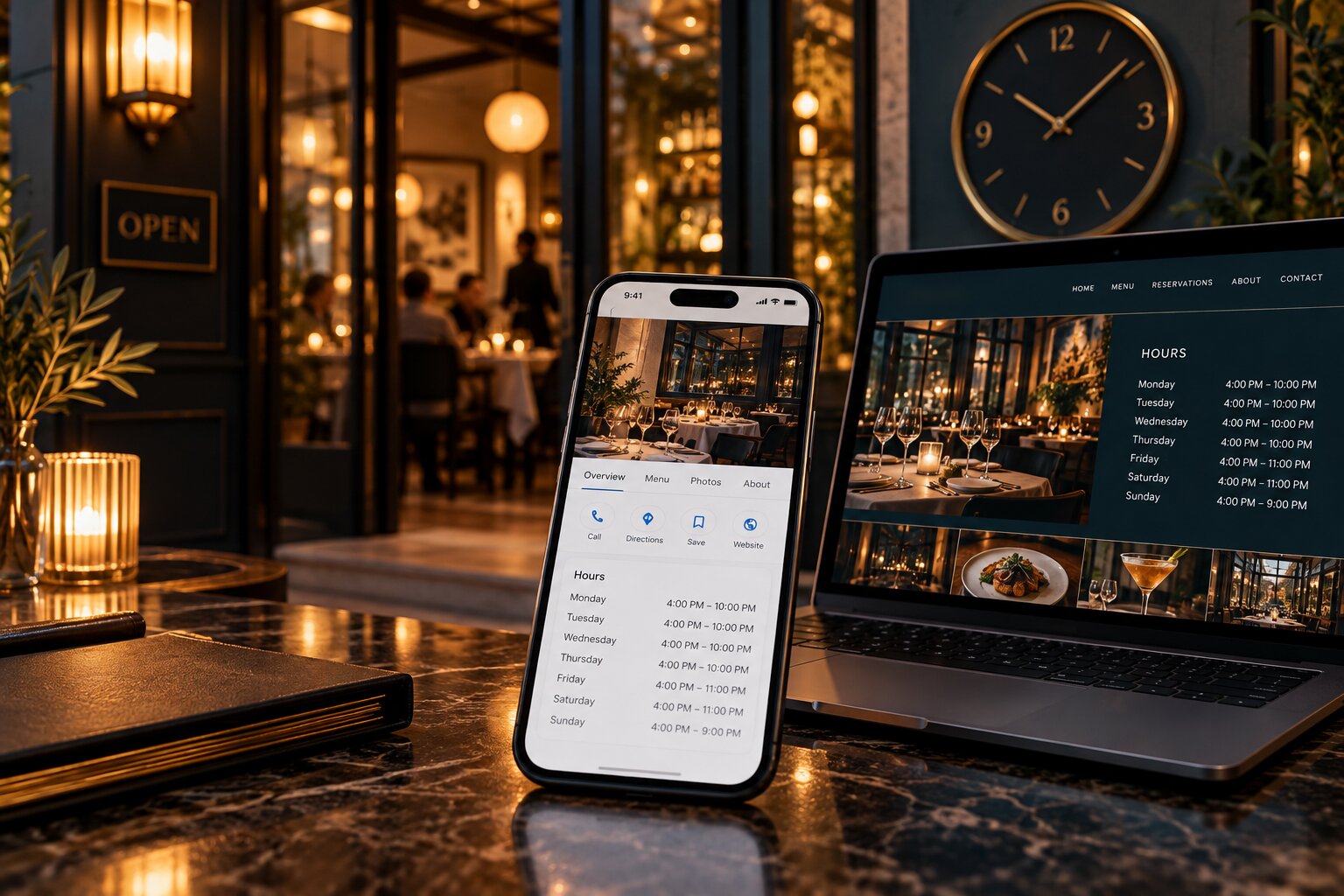
Hours Are One of the Most Important Local Details
A customer can forgive a lot of things online. Driving across town to find a locked door is not one of them. Restaurant hours are practical information with an immediate real-world consequence, which is why they deserve more attention than a forgotten footer update.
Your regular hours should match across your website, Google Business Profile, social profiles, and major listings whenever possible.
This sounds simple, but restaurant hours are one of the easiest details to let drift. A change gets made in one place, another platform gets forgotten, and suddenly customers are looking at two or three different versions of the same schedule.
That creates confusion fast. If Google says you close at 10, Facebook says 9, and the website says 11, the customer has to decide which source they trust. Plenty of people will not bother calling to verify it. They will pick somewhere else.
Hours Affect More Than Convenience
Accurate hours are not only about avoiding frustrated customers. They can influence how people plan their visit in the first place.
Someone searching for dinner at 8:30 wants to know whether there is enough time to get there and order. A customer looking for brunch wants to know whether breakfast service is still available. Someone driving from another city may be deciding whether your restaurant fits into the rest of their plans.
When the information is clear and consistent, the decision feels easy. When it is vague or conflicting, the customer has to do extra work.
That is exactly the kind of friction a restaurant website needs to remove.
Your Website and Google Need to Tell the Same Story
For many customers, Google is the first place they see your hours. Your website is often the second.
Those two sources need to agree.
If the website shows one schedule and Google shows another, customers may assume one of them is outdated. That can make the entire online presence feel less reliable.
Consistency also helps search engines understand which information about your restaurant is current. Your website, Google Business Profile, and other local listings all contribute to the picture search engines build about the business.
The goal is simple. Wherever someone looks, they need to find the same answer.
Special Hours Need Their Own Routine
Holidays, private events, seasonal schedules, weather closures, and staffing changes can all create temporary hours that do not fit the normal week. If those changes are only announced in one Facebook post, plenty of customers will never see them.
Update the places people actually check before leaving home. Google and your website should be at the top of that list.
Special hours deserve a repeatable process instead of an improvised one. When Thanksgiving, Christmas Eve, New Year’s Day, or another holiday approaches, there needs to be a clear list of places to update.
The same applies to one-off changes. If the restaurant closes early for a private party, opens late because of weather, or changes the schedule during the slow season, customers need that information where they are most likely to look for it.
Do Not Rely on Social Media Alone
Social media is useful for announcing changes, but it is not a reliable replacement for accurate business information.
A post about adjusted hours may disappear quickly in the feed. Someone visiting your page several days later may never see it. A customer coming from Google may not check Facebook or Instagram at all.
That is why the website and Google Business Profile matter so much. They act as reference points customers expect to be current.
Social media can reinforce the update, but it should not be the only place the information exists.
Multiple Locations Make Accuracy Even More Important
If your restaurant has more than one location, hours can become even more confusing.
One location may open earlier. Another may close later. Weekend schedules may be different. Holiday hours may vary from one location to another.
Each location needs its own clear information.
The website should make it obvious which hours belong to which restaurant, and Google Business Profiles need to be updated individually.
Customers should never have to guess whether the hours they are reading apply to the location they plan to visit.
Hours Need to Be Easy to Find
Accurate hours are only useful if customers can actually find them.
They do not need to be hidden deep inside a contact page or buried in a long footer. Depending on the restaurant, hours may belong on the homepage, location page, contact page, or all three.
On mobile, they need to be especially easy to access because many customers are checking hours while they are already out and making a decision.
A simple, readable hours section can do more for the customer experience than another decorative section on the homepage.
Make Sure Kitchen Hours and Business Hours Are Clear
Some restaurants have more than one schedule.
The bar may stay open later than the kitchen. Lunch service may end before the restaurant closes. Brunch may only run during a certain part of the day. Online ordering may stop before the dining room closes.
If that applies to your restaurant, be clear about it.
Writing “Open until 11” is not very helpful if the kitchen stops taking orders at 9:30. Customers need to know what the hours actually mean.
A little extra clarity can prevent a lot of frustration.
Accurate Information Builds Trust
Local SEO is partly about helping search engines understand your business, but it is also about helping customers trust the information they find. When every source says something different, that trust starts to disappear before they ever walk through the door.
Keeping hours consistent is not glamorous
Hours Are One of the Most Important Local Details
A customer can forgive a lot of things online. Driving across town to find a locked door is not one of them. Restaurant hours are practical information with an immediate real-world consequence, which is why they deserve more attention than a forgotten footer update.
Your regular hours should match across your website, Google Business Profile, social profiles, and major listings whenever possible.
This sounds simple, but restaurant hours are one of the easiest details to let drift. A change gets made in one place, another platform gets forgotten, and suddenly customers are looking at two or three different versions of the same schedule.
That creates confusion fast. If Google says you close at 10, Facebook says 9, and the website says 11, the customer has to decide which source they trust. Plenty of people will not bother calling to verify it. They will pick somewhere else.
Hours Affect More Than Convenience
Accurate hours are not only about avoiding frustrated customers. They can influence how people plan their visit in the first place.
Someone searching for dinner at 8:30 wants to know whether there is enough time to get there and order. A customer looking for brunch wants to know whether breakfast service is still available. Someone driving from another city may be deciding whether your restaurant fits into the rest of their plans.
When the information is clear and consistent, the decision feels easy. When it is vague or conflicting, the customer has to do extra work.
That is exactly the kind of friction a restaurant website needs to remove.
Your Website and Google Need to Tell the Same Story
For many customers, Google is the first place they see your hours. Your website is often the second.
Those two sources need to agree.
If the website shows one schedule and Google shows another, customers may assume one of them is outdated. That can make the entire online presence feel less reliable.
Consistency also helps search engines understand which information about your restaurant is current. Your website, Google Business Profile, and other local listings all contribute to the picture search engines build about the business.
The goal is simple. Wherever someone looks, they need to find the same answer.
Special Hours Need Their Own Routine
Holidays, private events, seasonal schedules, weather closures, and staffing changes can all create temporary hours that do not fit the normal week. If those changes are only announced in one Facebook post, plenty of customers will never see them.
Update the places people actually check before leaving home. Google and your website should be at the top of that list.
Special hours deserve a repeatable process instead of an improvised one. When Thanksgiving, Christmas Eve, New Year’s Day, or another holiday approaches, there needs to be a clear list of places to update.
The same applies to one-off changes. If the restaurant closes early for a private party, opens late because of weather, or changes the schedule during the slow season, customers need that information where they are most likely to look for it.
Do Not Rely on Social Media Alone
Social media is useful for announcing changes, but it is not a reliable replacement for accurate business information.
A post about adjusted hours may disappear quickly in the feed. Someone visiting your page several days later may never see it. A customer coming from Google may not check Facebook or Instagram at all.
That is why the website and Google Business Profile matter so much. They act as reference points customers expect to be current.
Social media can reinforce the update, but it should not be the only place the information exists.
Multiple Locations Make Accuracy Even More Important
If your restaurant has more than one location, hours can become even more confusing.
One location may open earlier. Another may close later. Weekend schedules may be different. Holiday hours may vary from one location to another.
Each location needs its own clear information.
The website should make it obvious which hours belong to which restaurant, and Google Business Profiles need to be updated individually.
Customers should never have to guess whether the hours they are reading apply to the location they plan to visit.
Hours Need to Be Easy to Find
Accurate hours are only useful if customers can actually find them.
They do not need to be hidden deep inside a contact page or buried in a long footer. Depending on the restaurant, hours may belong on the homepage, location page, contact page, or all three.
On mobile, they need to be especially easy to access because many customers are checking hours while they are already out and making a decision.
A simple, readable hours section can do more for the customer experience than another decorative section on the homepage.
Make Sure Kitchen Hours and Business Hours Are Clear
Some restaurants have more than one schedule.
The bar may stay open later than the kitchen. Lunch service may end before the restaurant closes. Brunch may only run during a certain part of the day. Online ordering may stop before the dining room closes.
If that applies to your restaurant, be clear about it.
Writing “Open until 11” is not very helpful if the kitchen stops taking orders at 9:30. Customers need to know what the hours actually mean.
A little extra clarity can prevent a lot of frustration.
Accurate Information Builds Trust
Local SEO is partly about helping search engines understand your business, but it is also about helping customers trust the information they find. When every source says something different, that trust starts to disappear before they ever walk through the door.
Keeping hours consistent is not glamorous marketing work. It is basic digital housekeeping, and for restaurants it can directly affect whether someone chooses to make the trip.
Accurate information also makes the rest of your marketing more effective. A beautiful website, strong photography, great reviews, and an active social presence do not help much if the customer cannot confidently tell whether you are open.
Create a Simple Hours Update Checklist
Restaurant hours are easier to manage when there is a routine behind them.
Any time the schedule changes, check the same places:
- Your website
- Google Business Profile
- Instagram profile information if hours are listed there
- Online ordering platforms
- Reservation platforms
- Major directory listings
- Any location specific pages
You may not use every platform on that list, but the principle is the same. Know where your hours appear and keep those sources aligned.
Customers Should Never Have to Guess Whether You Are Open
Restaurant websites and local listings work best when they remove uncertainty.
A customer checking your hours is usually very close to making a real decision. They may be deciding where to eat tonight, whether to drive across town, or whether there is still time to place an order.
Give them a clear answer.
When your website, Google listing, social profiles, and other major platforms all show the same accurate information, the experience feels reliable before the customer even arrives.
Google’s Business Profile hours guidance explains how businesses can keep normal and special hours current in Google Search and Maps. Your website should support that same clarity. Our Salt & Pixel Studio work connects the customer experience with local visibility, and our restaurant website design can help identify where the current site is creating gaps.